
Mobile App Development Process: A Complete Guide from Concept to Launch
Everything you need to know about the mobile app development process, timelines, phases, tech stack decisions, and common pitfalls.
May 7, 2026
Introduction
There's a moment every founder or product manager knows well. You have a clear idea, a genuine problem to solve, and a real belief that the right app could change how people work or live. Then someone asks, "So how does the development process actually work?" and the confidence fades a little.
It's a fair question. The mobile app development process is one of the most misunderstood journeys in tech. People assume it's mostly coding. In reality, coding is often the third or fourth thing that happens and whether a project succeeds or fails usually depends on decisions made long before a developer writes a single line.
At Ostryx, we've seen this pattern play out enough times to say with confidence: the teams that follow a structured development lifecycle launch faster, avoid expensive rework, and build products users actually want to keep using. The teams that skip phases don't save time, they just move the cost forward and make it harder to recover from.
What Is Mobile App Development?
Mobile app development is the end-to-end process of designing, building, testing, and deploying software applications for smartphones, tablets, and other portable devices. That scope covers native iOS and Android applications, cross-platform mobile apps, progressive web apps (PWAs), and increasingly, AI-powered mobile experiences that personalize and adapt to user behavior in real time.
From a purely technical standpoint, the process involves frontend UI development, backend infrastructure, API integration, cloud services, and ongoing maintenance. But defining it in technical terms alone misses something more fundamental. From a business perspective, mobile app development is about translating a user's need into a digital product that works reliably, feels intuitive, and delivers measurable value to the people using it.
The scale of the opportunity is hard to overstate. Over 5.78 billion people worldwide now own a smartphone, and the average user spends roughly 88% of their mobile screen time inside apps rather than browsers. Consumer spending on mobile apps and in-app purchases reached $150 billion in 2024, with year-over-year growth showing no signs of slowing. For businesses, a well-built mobile application can drive customer engagement, streamline internal operations, open entirely new revenue streams, and build the kind of brand loyalty a website alone cannot achieve.
The opportunity is real. So is the risk of building the wrong thing. A structured development process is what separates successful products from expensive lessons.
The 7 Phases of Mobile App Development
No two app projects are identical, but every successful mobile application travels through the same recognizable set of stages. These phases are not arbitrary checkboxes, each one produces something the next phase depends on. Skip a stage and you do not save time; you create a gap that shows up later as cost overruns, missed deadlines, or unhappy users.
Here is how the process actually works.
Phase 1: Discovery and Ideation
Every good app starts with a problem, not a feature list. The discovery phase, sometimes called product discovery, is where the development team, business stakeholders, and often potential users come together to define what the app actually needs to accomplish and who it is being built for.
The core principle here is one of the most important in all of software development: product discovery is about building the right thing, not just building the thing right. You can have flawless code, a performant backend, and a beautiful interface on a product that nobody wants to use. Discovery is what prevents that outcome.
During this stage, teams work through several foundational questions:
- What specific problem does this app solve, and is it a problem worth solving at scale?
- Who are the target users, and what pain points do they experience today?
- What does success look like, and how will it be measured in concrete terms?
- What does the competitive landscape look like, and where is the real opportunity to differentiate?
- What monetization model makes sense, subscription, freemium, one-time purchase, or enterprise licensing, and how does that influence the feature set?
This phase typically includes market research, competitor analysis, user interviews, user persona development, feature prioritization workshops, and early monetization strategy. The goal is not to produce a comprehensive feature list. The goal is to validate the core concept and establish a product direction that the whole team understands before anyone opens a design tool or writes a line of code.
At Ostryx, we treat discovery as a non-negotiable investment. The time spent understanding your users upfront pays back many times over in reduced rework and faster time-to-market. Skipping this phase is the single most common reason app projects go over budget.
Phase 2: Planning, Requirements, and Technical Scoping
Once the concept is validated, the planning phase converts ideas into actionable requirements and a realistic development roadmap. This is where the project moves from directional thinking to structured execution.
The planning stage defines both functional and non-functional requirements.
Functional requirements describe what the app does, the specific capabilities users interact with:
- User authentication and account management
- Payment processing and transaction flows
- Push notifications and in-app messaging
- Search, filtering, and content discovery
- Real-time communication or data syncing
- Third-party service integrations
Non-functional requirements describe how well the app performs under real conditions:
Feature prioritization happens here too, typically using MVP methodology. A minimum viable product includes only the core features necessary to solve the primary user problem and validate the product concept with real users. Launching with an MVP allows businesses to:
- Load time targets and response benchmarks
- Security standards and data protection protocols
- Scalability thresholds for concurrent users
- Offline behavior and data caching strategy
- Accessibility compliance under WCAG guidelines
- Platform-specific performance standards for iOS and Android
Starting with the full product vision built out is one of the most reliable ways to overspend without validating whether the product actually works.
- Reduce initial development mobile development costs and financial risk
- Test core assumptions in the market before committing to the full build
- Collect genuine user feedback that shapes every subsequent decision
- Reach early adopters sooner and begin building an audience
- Prioritize future features based on actual demand, not pre-launch assumptions
Choosing the Right Technology Stack
One of the most consequential decisions during planning is choosing between native and cross-platform development.
Native apps are built specifically for a single platform, Swift for iOS, Kotlin or Java for Android. They offer maximum performance, deeper hardware integration, and platform-specific experiences like Face ID, advanced camera controls, and background processing. Native development is the right choice for apps with heavy augmented reality requirements, real-time video processing, complex animations, or unusually demanding device sensor integration.
Cross-platform frameworks like Flutter and React Native allow developers to write a single codebase that compiles into apps for both iOS and Android. In 2026, the performance gap between cross-platform and native has narrowed dramatically. For most business applications, consumer apps, and MVPs, cross-platform development is the pragmatic choice, it can reduce costs by 30% to 40% compared to building two separate native products, and modern frameworks handle the majority of use cases without meaningful performance trade-offs.
The right technology stack decision depends on your users, your budget, your timeline, and the specific technical requirements of your product, not on which framework a development team happens to prefer.
Planning also covers team structure: whether to build in-house, engage an external development partner like Ostryx, or use a hybrid model. Each approach has genuine trade-offs around cost, speed, domain expertise, and long-term ownership of the codebase.
Phase 3: UI/UX Design and Prototyping
Design is where the app stops being an idea and starts becoming something tangible. Good mobile UI/UX design is not primarily about aesthetics, it is about making the app feel obvious. Users should always know what to do next without having to think about it. When they have to think, something in the design has failed.
The design process moves through three distinct stages, and the order matters.
- Wireframing comes first. Wireframes are intentionally low-fidelity, basic layouts that define screen structure, navigation flow, content hierarchy, and user journeys without any visual styling. By stripping away colors, typography, and branding at this stage, teams can focus entirely on whether the app's logic and flow actually make sense before any visual work begins.
- Interactive prototyping comes second. Clickable prototypes simulate the real app experience, users can tap through screens, trigger interactions, and experience the navigation as it will actually work. Prototyping before development begins enables real usability testing, validates design decisions, and surfaces friction points early when they are inexpensive to fix. Finding a fundamental navigation problem in a prototype costs hours. Finding the same problem after development is complete takes weeks.
- High-fidelity visual design comes third. This is where brand identity, color systems, typography, iconography, motion design, and UI components come together. The visual layer is what users remember and associate with your product. It is also where the emotional tone of the app gets established, whether it feels trustworthy, energetic, calm, or playful.
UX considerations run throughout all three stages: touch target sizing, gesture navigation, loading state behavior, error message design, onboarding flows for first-time users, and accessibility features for users with visual or motor impairments.
The principle the Ostryx design team holds firmly: wireframes come before visual design, and user flows get validated before interfaces get polished. Reversing that order is one of the most common, and most expensive, mistakes in mobile product development.
Phase 4: Frontend and Backend Development
Development is the longest and most resource-intensive phase. It is where the product moves from designed screens to working software, and it is where the quality of all previous planning becomes visible.
Modern development teams run this phase using Agile methodology, typically in two-week sprints. Each sprint focuses on a defined set of features, delivers working software that stakeholders can review and test, and creates a natural checkpoint for feedback and reprioritization. This approach keeps teams aligned, surfaces problems early, and prevents the scenario where developers build for months only to discover they have drifted significantly from what users actually need.
Development runs on two parallel tracks.
Frontend development
Frontend development covers everything users see and interact with directly: implementing the user interface from design specifications, handling user inputs, managing navigation between screens, building responsive layouts that work across different device sizes and orientations, and implementing animations and transitions that make the app feel polished.
Backend development
Backend development builds the infrastructure that makes the frontend work: servers, databases, authentication systems, REST or GraphQL APIs, cloud services, data storage, and the business logic that processes everything happening beneath the interface. Backend architecture is what determines how well an app scales when user numbers grow, how securely it handles sensitive data, and how efficiently it processes requests under load. A well-architected backend built for scalability from the beginning is significantly cheaper than rebuilding one under pressure when traffic grows.
Third-party integrations layer in during this phase as well. Payment gateways like Stripe or PayPal, mapping services, social login providers, analytics platforms, push notification services, and cloud storage systems all need to be connected and tested as part of the core application.
API design deserves particular attention during development planning. Whether you are building a RESTful API or using GraphQL, the structure of the data layer has cascading effects on app performance, flexibility, and the ease of adding new features in future development cycles.
Phase 5: Quality Assurance and Testing
Testing is not a final checkpoint before launch. In a well-run development process, QA begins alongside coding from the earliest sprints and runs continuously until deployment.
The logic is straightforward: bugs found early are cheap to fix. Bugs found after launch are expensive to fix and damaging to user trust. By building test coverage into every feature as it is developed, teams avoid the scenario where a months-long build gets handed to QA two weeks before launch and critical issues surface with no time to address them properly.
A thorough mobile app testing process covers several distinct categories.
- Functional testing verifies that every feature works as intended, login flows, payment processing, notification delivery, search functionality, data submission, and every user-facing interaction the app supports.
- Performance testing evaluates how the app behaves under real-world conditions: load times, responsiveness under heavy usage, stability on slow or intermittent network connections, and memory management during extended sessions. Users expect apps to respond in under three seconds. Apps that do not meet that expectation generate poor reviews and high churn.
- Security testing looks for vulnerabilities in the system, whether user data is properly encrypted, whether API endpoints are protected against unauthorized access, whether authentication systems can be bypassed, and whether sensitive information is handled safely throughout the data flow.
- Usability testing puts real users in front of the app to observe how they actually interact with it. Usability testing reveals navigation confusion, friction in core flows, and UX problems that internal teams often miss because they are too close to the product.
- Compatibility testing verifies that the app behaves consistently across different devices, screen sizes, and operating system versions, from the latest iPhone on iOS 18 to older Android devices still running earlier OS versions.
- Accessibility testing, ensuring the app works for users with visual impairments, motor limitations, or cognitive differences, is increasingly important both as a matter of user inclusion and because both Apple and Google have strengthened their accessibility review requirements.
The combination of automated testing for regression coverage and manual testing for edge cases and subjective UX evaluation is what separates production-ready applications from ones that generate one-star reviews in the first week after launch.
Phase 6: Deployment and App Store Launch
Getting an app live is more involved than pressing publish. Both the Apple App Store and Google Play Store have structured review processes, technical submission requirements, metadata standards, and content guidelines that need to be satisfied before an app becomes publicly available.
Deployment preparation involves configuring production builds, setting up code signing certificates, completing privacy compliance documentation, and creating store listings that are optimized for both review approval and user discoverability.
A strong store listing includes a clear, keyword-informed app title and description, high-quality screenshots that communicate the product's core value within the first two images, a compelling preview video, and review responses that signal an active and responsive development team. App Store Optimization, the practice of optimizing store listing metadata to improve organic discoverability within app marketplaces, should be treated as a launch deliverable, not an afterthought. The keywords you choose in your app title and description directly affect how many users find you through in-store search.
A staged rollout strategy reduces launch risk significantly. Rather than releasing to all users simultaneously, staged releases deploy the app to a small percentage of users first. This allows teams to monitor crash rates, track early reviews, identify critical issues, and resolve them before they affect the full user base.
Phase 7: Post-Launch Maintenance, Monitoring, and Growth
Launch day is not the finish line. For most successful apps, it is closer to the starting line of the longer and more important race.
The apps that grow are the ones that keep improving. A mobile product that is not actively maintained depreciates quickly, Apple and Google release major OS updates annually, device hardware evolves, user expectations rise, and security vulnerabilities require ongoing attention. An app that looked and worked great at launch can become a liability within eighteen months if maintenance is neglected.
Post-launch activity falls into three ongoing categories.
Maintenance covers bug fixes, OS compatibility updates, security patches, and third-party dependency updates. None of this is optional, it is the baseline cost of keeping a live product functional and trustworthy.
Monitoring involves tracking the metrics that reveal how real users are actually experiencing the product: crash rates, session duration, user retention cohorts, feature adoption rates, conversion funnel performance, and in-app behavior patterns. Analytics data tells you what is happening. It does not always tell you why, which is where user feedback becomes essential.
Iteration is where long-term product value gets built. User feedback from app store reviews, in-app surveys, customer support conversations, and behavioral analytics feeds into development planning for the next cycle. Features that were excluded from the MVP get prioritized based on demonstrated user demand rather than pre-launch assumptions. This feedback loop, ship, measure, learn, improve, is the mechanism through which good products become great ones.
At Ostryx, post-launch support is built into every engagement from the beginning, because the teams that treat launch as the end of the process consistently underperform against the ones who treat it as the beginning.
How Long Does Mobile App Development Take?
Development timelines vary significantly based on complexity, team size, and the quality of requirements going into the build.
Simple apps with limited functionality typically take one to three months. Medium-complexity apps with user authentication, payment processing, push notifications, dashboards, and third-party integrations generally require three to six months. Complex applications with real-time features, AI and machine learning capabilities, custom backend architecture, or multi-role access systems typically take six to nine months. Enterprise-grade platforms with advanced security requirements, compliance needs, and large-scale infrastructure can require nine to twelve months or longer.
These ranges assume clear, well-defined requirements going into development. Unclear or frequently shifting requirements are the most common cause of timeline overruns, not technical complexity. The investment in thorough discovery and planning typically saves two to three times that effort in development rework later.
Common Challenges in Mobile App Development
Every app project runs into friction. The difference between teams that ship well and teams that struggle is usually how prepared they were for the predictable problems.
Scope creep is the most reliable budget killer. Stakeholders add features mid-development and each addition compounds the complexity of what came before. The solution is a structured change management process where every new request is evaluated for its impact on timeline and budget before it gets accepted.
Device and OS fragmentation means your app needs to work consistently across a wide range of hardware, screen sizes, and software versions. Responsive design principles, prioritized device testing matrices, and continuous compatibility testing are the standard mitigations.
Performance optimization is an ongoing discipline, not a one-time task. Efficient code architecture, image compression and lazy loading, intelligent caching, reduced API call frequency, and background processing management all contribute to the sub-three-second load times users expect.
Security needs to be designed into the product architecture from day one, not applied as a layer afterward. Data encryption, secure authentication protocols, proper session management, API protection, and regular penetration testing are table stakes for any app handling personal, financial, or health-related data.
Mobile App Development in 2026: What Has Changed
The foundational phases of app development remain consistent, but the tools, benchmarks, and competitive environment have shifted meaningfully.
AI integration has moved from a differentiator to an expectation in many product categories. Modern apps increasingly include:
- On-device machine learning for intelligent personalization
- Conversational interfaces and AI-powered assistants
- Predictive automation that anticipates user needs
- Intelligent search and context-aware recommendations
- Agentic AI workflows that reduce operational friction
Agentic AI implementations in mobile products are demonstrably reducing operational response times for businesses that have architected them correctly.
Cross-platform frameworks have matured significantly. Flutter and React Native now handle complex animations, deep hardware integrations, and high-traffic production loads that would have required fully native development just three years ago. For most business and consumer applications, cross-platform is the rational starting point.
The mobile-first expectation is now universal. Global mobile internet usage exceeds 60% of all web traffic. For consumer-facing products, mobile-first is not a strategic choice, it is the baseline from which everything else is designed.
The quality bar has risen across the board. Users have experienced great apps and they know what good feels like. In 2026, the minimum bar for holding user attention includes:
- Sub-three-second load times across all screens
- Smooth, crash-free performance on both new and older devices
- Intuitive navigation that requires no onboarding explanation
- Regular updates that show the product is actively maintained
- Consistent behavior across iOS and Android platforms
An app that would have stood out in 2020 now simply needs to meet these baselines just to compete.
What to Look for in a Mobile App Development Partner
Choosing the right development partner is one of the highest-leverage decisions in an app project. A strong partner costs more upfront than a weak one. The wrong choice typically costs significantly more in total.
Strong development partners start with discovery and resist pressure to skip it. They ask difficult questions about your users, your business model, and how you will measure success before they discuss technology choices. They can clearly articulate why Flutter or React Native is the right choice for your specific context, or why native development is genuinely warranted, grounded in your requirements rather than their own preferences.
They integrate QA throughout development rather than bolting it on at the end. They show you working software at regular intervals rather than disappearing for months and returning with a finished build that has drifted from the original intent. And they plan for post-launch maintenance from the first conversation, because they understand that is where real product value gets built and protected.
At Ostryx, our approach is built around exactly this framework, structured phases, transparent progress at every sprint, and a genuine focus on outcome rather than just deliverability. Whether you are scoping an MVP or scaling an existing application, we work through the problem with you before we talk about the solution.
Why Choose Ostryx for Your Mobile App Development?
There is no shortage of development agencies. The real question is not whether you can find a team to build your app, it is whether you can find a team that will build the right app, the right way, and still be around and invested in the product twelve months after launch.
Ostryx was built specifically to solve the problems that cause most app projects to underdeliver: unclear discovery, disconnected design and development, QA treated as an afterthought, and partners who disappear once the final invoice is paid.
Here is what working with Ostryx actually looks like:
We start with your problem, not our stack. Every engagement begins with a structured discovery process. We ask hard questions about your users, your business goals, and how you will measure success before we recommend a single technology or write a single line of code. Our technology recommendations are grounded in your requirements, not in what we happen to prefer building with.
We design for users, not portfolios. Our UI/UX process follows a strict order: wireframes before visuals, user flow validation before interface polish, prototype testing before development begins. We do not hand over beautiful screens that are confusing to use. We hand over designs that have been tested with real users and proven to work before development starts.
We build for scale from day one. Our backend architectures are designed to grow with your user base, not to be rebuilt when you hit traction. Whether you are launching an MVP or a full-scale platform, the technical foundation we build is one you will not have to rip out in eighteen months.
We integrate QA throughout, not at the end. By the time a feature ships from our development team, it already has test coverage. Our dedicated QA phase then adds structured validation across devices, OS versions, network conditions, and real-world edge cases. We do not deliver builds that generate one-star reviews on launch day.
We keep you in the loop at every sprint. Stakeholders see working software every two weeks. You can provide feedback, reprioritize features, and course-correct before the build drifts from the original intent. No black-box development, no surprises six months in.
We plan for a post-launch from the first conversation. Maintenance, monitoring, and iterative improvement are not add-ons we upsell after launch. They are part of how we scope and plan every project from the beginning, because we know that is where real product value gets built and protected over time.
If you are looking for a team that treats your product with the same seriousness you do, one that pushes back when something is not right, communicates clearly when something is at risk, and stays invested long after the launch, Ostryx is built for exactly that kind of partnership.
- End-to-end mobile app development across iOS, Android, and cross-platform
- Product discovery and market validation workshops
- UI/UX design, wireframing, and user-tested interactive prototyping
- Native development in Swift and Kotlin, and cross-platform development in Flutter and React Native
- Scalable backend architecture, REST and GraphQL API development, and cloud infrastructure
- Comprehensive QA including functional, performance, security, usability, and compatibility testing
- App Store and Google Play submission, ASO strategy, and staged rollout planning
- Post-launch monitoring, maintenance, and iterative feature development
What Ostryx Brings to Every Project
Frequently Asked Questions
It's a structured sequence of phases that takes a product idea from concept to live application - covering discovery, planning, UI/UX design, development, QA testing, App Store deployment, and post-launch maintenance.
Simple apps take 1 to 3 months. Medium-complexity apps with payments and integrations take 3 to 6 months. Complex apps with AI or custom backends take 6 to 9 months. Enterprise platforms can require 12 months or more.
An MVP (minimum viable product) is the smallest version of your app that solves the core user problem. It lets you launch faster, reduce costs, and validate your idea with real users before building the full product.
Native apps are built separately for iOS (Swift) and Android (Kotlin), best for maximum performance. Cross-platform apps like Flutter or React Native use one shared codebase for both platforms, cutting costs by 30 to 40 percent.
Because users uninstall apps they find confusing, regardless of how well the code is written. Good design improves retention, reduces support volume, increases conversions, and creates experiences people recommend to others.
The work continues. Post-launch means fixing bugs, pushing OS compatibility updates, monitoring analytics, collecting user feedback, and iterating on features. Apps that stop improving lose users fast.
Simple apps start from $5,000 to $50,000. Mid-complexity apps range from $50,000 to $150,000. Complex apps with AI and custom infrastructure can reach $300,000 or more. Cross-platform development typically costs less than building two separate native apps.
Recent Insights
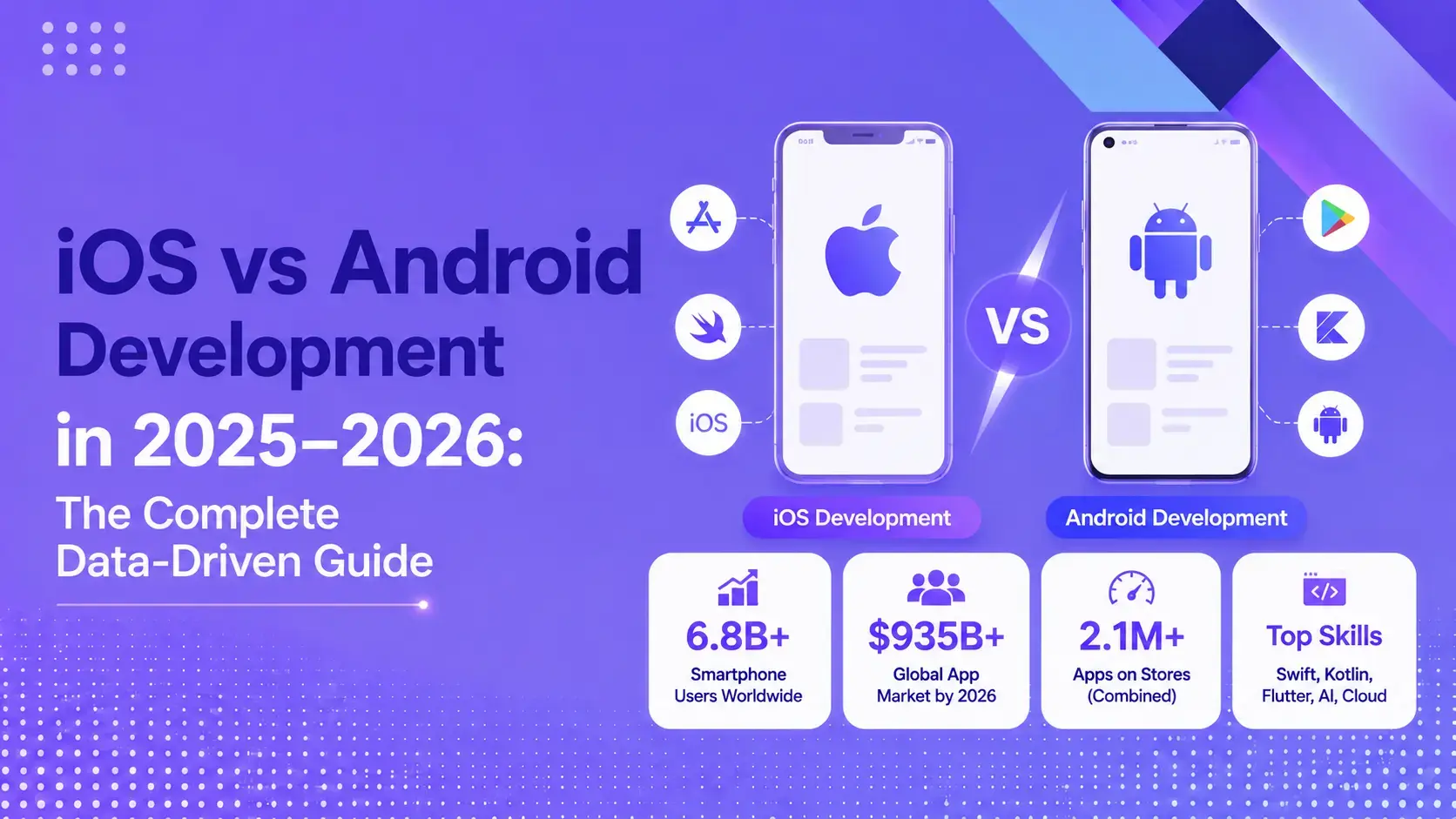
iOS vs Android Development in 2025–2026: The Complete Data-Driven Guide
May 19, 2026
AI in Healthcare: Real Use Cases, HIPAA Compliance & ROI in 2026
May 16, 2026
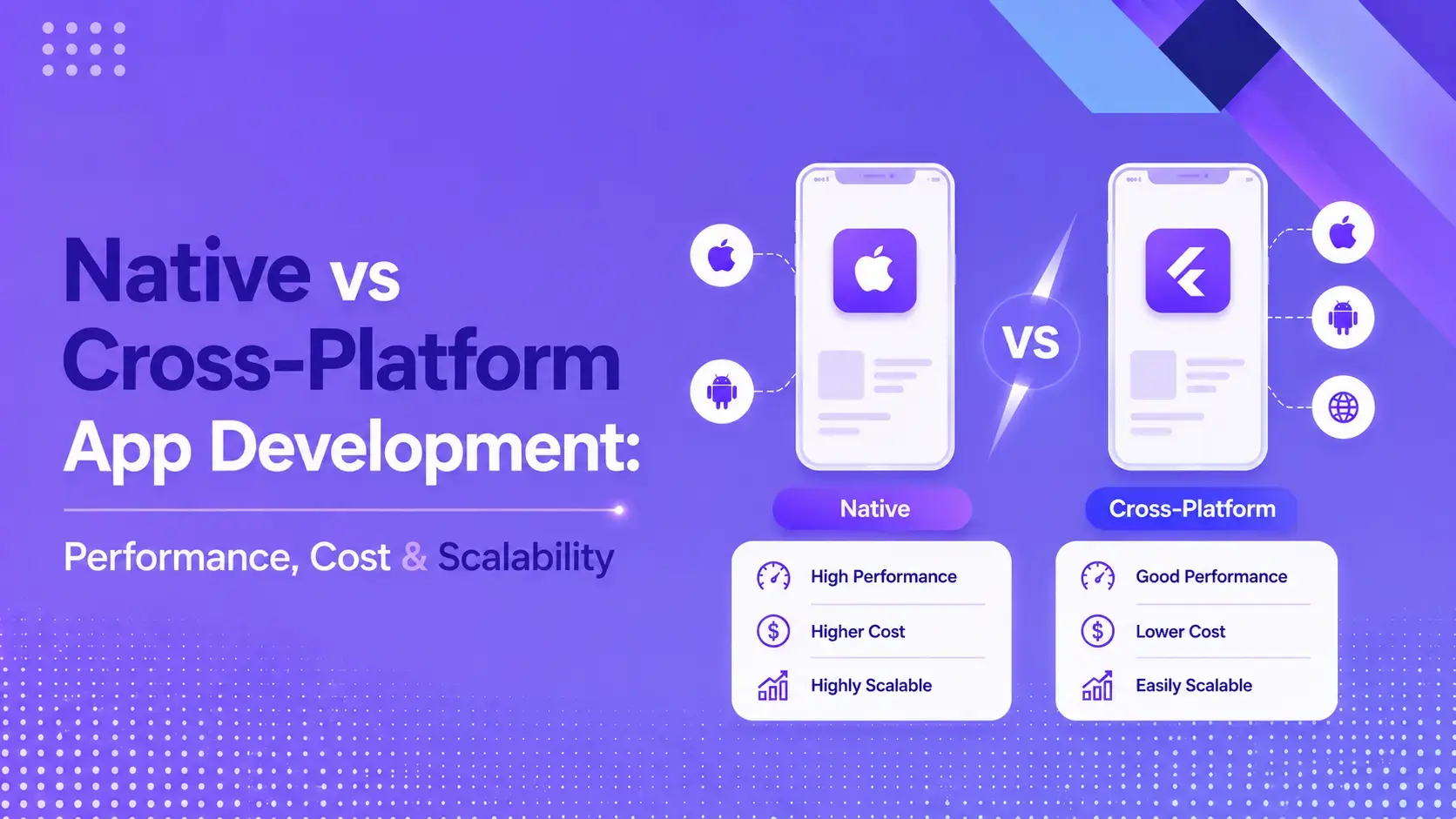
Native vs Cross-Platform App Development: Performance, Cost & Scalability
May 15, 2026
Claude vs ChatGPT (2026): Which AI Assistant Is Better?
May 12, 2026
Services & Solutions
Let's Connect
info@ostryx.com
+1 (850) 586-1700
2A Church Street, Toronto

Let's Build Together!

© All rights reserved 2026
